During the pandemic, Tadvic went through periods of inactivity.
We continued to accept Requests for Assistance on a case-by-case basis.
We eventually resumed client visits subject to compliance with the restrictions of Victoria’s health authorities.
We continue to explore new ways to operate. We will work remotely via your Occupational Therapist / Physiotherapist using video technology if requested.
Our client walks with the aid of a gutter frame. She asked for a tray on which she could carry her morning cup of tea and a bowl of porridge.
Essentially, a tray was needed that could be affixed to the two parallel steel tubes that ran lengthwise between the two “legs” of the walker. Depending on the surrounding space available to the client, the tray should be as wide as possible but able to be folded in half in order to reduce the space it occupied when the client was operating in a confined space. The tray should have two holes into which her mug and bowl would fit. These were positioned in the outer half of the tray so that they were available regardless of whether the tray was extended or folded back.
A notch was made in one hole to accept the handle of the mug.
The tray was made easily removable, by using 4 “tool clips” screwed to the underside of the rear section of the tray.
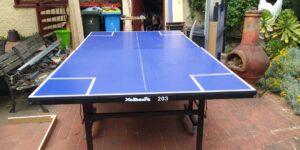
Rory is 12 years old and blind. He plays Vision Impaired Table Tennis (“Swish”) at Kooyong and his family asked Tadvic to make a table for use at home.
Swish is played on a standard width (1.52m) table tennis table but the length is extended from to 2.74 to 3.66m.
A standard competition table tennis table was used as the starting point. This table comes in two separate rollaway sections for storage.
Standard Table
“Swish” has guide rails along the sides. Players use small bats and a plastic ball with holes and a rattle inside.
An additional half table top was purchased and cut to size to make the required table length and a rollaway steel frame was built to hold it and the “net” (which is a solid wall with a gap at the bottom).
The table width can be reduced to 1m for singles by inclusion of a rail on the table top.
Rory playing Singles on the modified table
Tadvic has since made 2 more tables for “Swish” Clubs around Melbourne. We have found Clubs play a lot harder than Rory did at the time, so the subsequent tables had to be built stronger.
We have also supplied details to a school in Queensland and to an organisation for the blind and visually impaired people in Romania. Please contact us if you would like detailed plans of our conversion process.
Our client is an adult with autism. He is non-verbal but very mobile.
His Occupational Therapist requested an arrangement of devices for aural, mental and physical stimulation.
Tadvic created a box with two lids and an open area in the middle to fit a future activity device. Various devices were fitted to the left-hand lid. Adjustable bolt & nut arrangements were placed on both front face ends. A ratchet wheel and bike bell were fitted.
The entire unit sits on a portable piano stand or can be placed on a table top or on the floor. The apparatus provides stimulus for the client with regard to movement, dexterity, audio and feel.
Our client is 6 years old and has Cerebral Palsy. She cannot get into her family’s SUV independently. She is growing too big to be lifted into the vehicle.
We considered options like a footplate fixed to the vehicle but multiple steps were required.
Instead we modified a folding multi-step. The legs were made extendable, so the steps could be used against a curb (as shown) or extended in situations like a car park. The top step goes across the car door sill and is retained against the inside.
The steps in place
The steps fold flat for storage in the vehicle with the wheelchair.
Our client uses a powered wheelchair and has limited hand and arm movement. She often finds she cannot reach the buttons in lifts etc.
She tried a telescopic “pen” pointer that could fit into a handbag. It was stiff enough to press a button but too stiff for her to extend and retract.
Tadvic produced a 3 section pointer made from fibreglass tent poles. These remain connected via an elastic cord down the central core and are easily folded to fit in her handbag. When extended they are rigid.
Occupational Therapists at a major Melbourne public hospital requested a bath that could be used to train patients in wheelchairs to transfer to and from a bath. (The hospital has showers, but no standard baths.)
The bath is not plumbed in (i.e. it is used for “dry runs”). It must meet hospital infection control standards. The bath unit could not have any exposed timber and all surfaces must be able to be wiped down with the hospital approved cleaning product which is bleach based.
A standalone bath was considered as a solution but they tend to have higher sides than clients would encounter at home. This approach was rejected.
The hospital bought the majority of required materials and Tadvic agreed to construct the bath support/surround. The bath sits on rubber tipped feet and can be moved if required. Training can be with a bath bench (as shown) or a bath board.
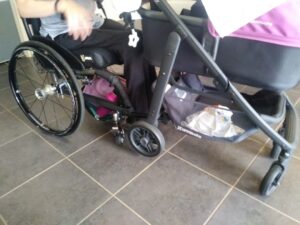
Our client is paraplegic and uses a manual and a powered wheelchair. She has just had her first baby and asked Tadvic to provide a connection between the wheelchairs and a stroller so she can move her child around.
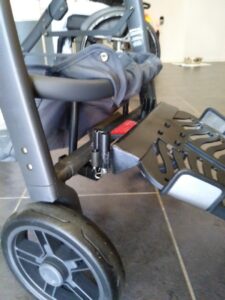
To enable steering, the fixed rear wheels need to be off the ground and the stroller turns on its swivel front wheels. We provided connections for each wheelchair.
For the powered wheelchair our client drives the footplate under the rear axle of the stroller and lifts the axle with the powered footplate. When not using the stroller the connection folds back flat with the footplate.