In June 2025, we described our efforts to provide an accurate tuner for a blind musician. We failed to achieve the desired accuracy. So, we started again.
This time we used an accurate commercial tuner, the Peterson Apps for iPhone (iStrobosoft) or Android (Strobe). Peterson claims the same +/-0.1 cent accuracy as their dedicated strobe tuners. The App costs around US$10.
The Apps display 4 columns with blocks of alternating colours (strobe effect) that move up when the pitch is sharp and down when it is flat. The speed of the moving colours is determined by how much the pitch is off the note (cents). The App also displays the cents numerically e.g. “+12.3”.
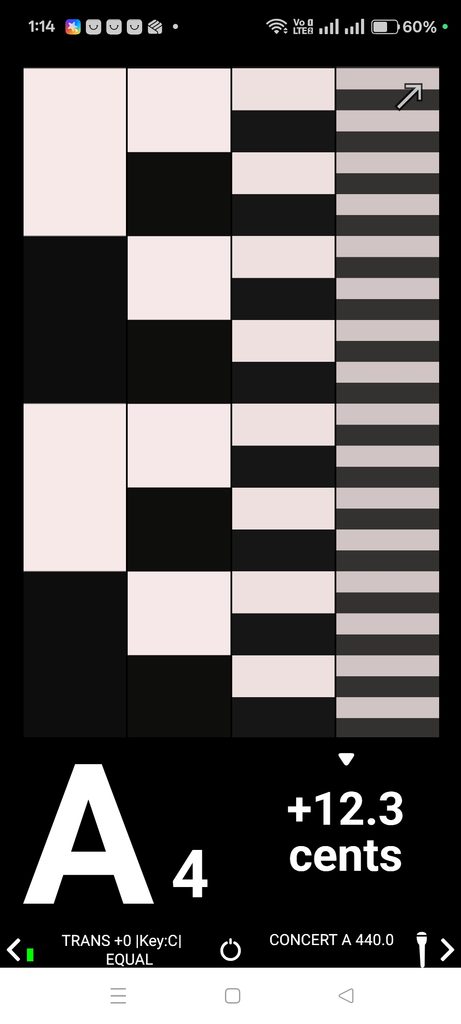
We started with the Android version. We used a Peterson Pitch Grabber connected to the phone’s audio socket to input the instrument pitch. This is immune to other noise in the room.
We then powered an ESP32S3 Camera microprocessor from the phone’s USB port in ‘On The Go’ (OTG) mode.
We mounted the ESP32S3 Camera (ov2640 120 degrees) about 25mm above the phone screen, focused on the numeric cents.
We created an Arduino sketch (program) for the ESP32, to repeatedly take grey bitmap images of the screen. We capture 20 frames per second of 320*240 pixels.
We convert the image to black and white and identify zones containing a sign, digits and a decimal point. We then compare the bits in each digit zone against saved “fingerprints” of the digits 0 to 9. The comparison accommodates some shifting of the image. Using this technique, we get the cents e.g. +12.3 (or reject the image if the cents cannot be extracted).
We connected stereo earphones to the ESP32 via a dual potentiometer for volume control.
We then generate beeps in the ESP32 that go to the left ear for flat and the right ear for sharp.
We generate 20 beeps a second at 20 cents (or more). The tempo reduces to 2 beats a second at 2 cents. The beeps have a 2000Hz frequency and last for 20 milliseconds.
Below 2 cents, the tempo ranges from 20 beeps a second at 2 cents and reduces to one beep a second at 0.1 cents. These beeps have a 200Hz frequency and last for 10 milliseconds. They are short clicks and easily differentiated from the beeps for higher cents.
The beeps are adjusted as the string is adjusted, and are updated 20 times a second.
When the cents are below 0.1, a tone is sent to both ears to signal successful tuning. This tone is at 500Hz for 100milliseconds.
Depending on the instrument quality, it may not hold +/-0.1 cents accurately, in which case the user gets beeps in alternate ears as the instrument wavers above and below 0 cents.
We have tested the tuner with various stringed instruments (from cheap ukelele to concert quality mandolin) using an Oppo A79 Android phone and have found it accurate and viable for a blind musician to tune an instrument in a noisy environment.
We expect the approach will work with any Android phone that supports the Peterson Strobe App. If OTG is not available, a battery could be added to power the ESP32.
We have also tested the Peterson iStrobosoft (iPhone) version. Depending on the iPhone model, an adaptor may be needed to connect the Pitch Grabber to a Lightning socket. It is possible to power external devices from some iPhones (different to OTG) or a battery could be added to power the ESP32.
We are not conveying the note. In general, musicians seeking +/-0.1 cents accuracy are using instruments that never drift into the next semitone, so our tuner enables bringing the string back to its semitone. The exception is when a new string is installed. This could be roughly tuned by ear, or a blind musician could get assistance from someone who can see the note on the App. Further development could read the Note from the phone screen.
We have asked Peterson to build this into their Apps.
The sketch we have built is fast enough to process 20 images a second. However, if it is connected to an Arduino Independent Development Environment (IDE), it supports a range of reporting options for analysis (e.g. the entire camera image; individual digits displayed against their fingerprint; greyscale distribution table for setting black/white; the full set of fingerprints; the bitmap of a captured digit represented in bytes for inclusion in the sketch). These guide the setting of a few parameters to optimise the systems performance.
Contact Tadvic if you would like more information, including construction notes and a copy of the ESP32 sketch.